

Why Crochet Ergonomics Matters for Every Crafter
If you have ever put down your crochet hook after a long session and felt a dull ache in your wrist, a cramp in your fingers, or stiffness in your neck and shoulders, you are not alone. Crochet is a repetitive motion activity, and like any repetitive activity — typing, playing an instrument, painting — it can lead to strain and injury if you do not pay attention to how your body is positioned and how you are moving.
The good news is that most crochet-related discomfort is preventable. With the right hook, proper posture, regular breaks, and a few targeted stretches, you can crochet comfortably for hours — and continue enjoying the craft for decades without developing chronic pain. This guide covers everything beginners and experienced crocheters need to know about crochet ergonomics, from choosing an ergonomic hook to setting up your workspace for maximum comfort.
At WooHobby, we believe that crochet should be a source of relaxation, not pain. Many of our Beginner Crochet Kits include hooks with ergonomic handles specifically because we want new crafters to develop healthy habits from day one. It is far easier to learn good ergonomics at the start than to unlearn years of tension and poor posture later.
Understanding Repetitive Strain Injury (RSI) in Crochet
What Is RSI and Why Do Crocheters Get It?
Repetitive Strain Injury (RSI) is an umbrella term for pain in muscles, nerves, and tendons caused by repetitive movement and overuse. In crochet, the same small hand movements — wrapping yarn, pulling through loops, gripping the hook — are repeated hundreds or thousands of times in a single session. If you crochet for two hours and average 20 stitches per minute, that is 2,400 repetitions of the same motion. Over days, weeks, and months, that repetition adds up.
The most common RSI conditions among crocheters include:
- Carpal tunnel syndrome: Compression of the median nerve as it passes through the wrist, causing numbness, tingling, and weakness in the thumb, index, and middle fingers. Crocheters who hold their hooks with a tight "pencil grip" are especially susceptible because this grip position flexes the wrist forward, narrowing the carpal tunnel.
- De Quervain's tenosynovitis: Inflammation of the tendons on the thumb side of the wrist, causing pain when gripping or twisting. This is common in crocheters who use a "knife grip" and move their thumb repeatedly to guide the yarn.
- Trigger finger (stenosing tenosynovitis): A condition where a finger or thumb catches or locks in a bent position due to inflammation of the tendon sheath. The repetitive gripping and releasing of the crochet hook can trigger this.
- Tennis elbow (lateral epicondylitis): Pain on the outside of the elbow from overuse of forearm muscles. Crocheters who work with tight tension and stiff yarn may overload these muscles.
- Neck and shoulder strain: From looking down at your work for extended periods or hunching forward, which compresses the cervical spine and strains the trapezius muscles.
The key point is that none of these conditions develop overnight. They build gradually, and the early warning signs — mild aching, occasional tingling, stiffness after crocheting — are easy to ignore. By the time the pain is severe enough to make you stop crocheting, significant inflammation or nerve compression may already be present. Prevention is far easier than treatment.

Choosing the Right Crochet Hook for Comfort
Ergonomic vs. Standard Hooks
The single most impactful change you can make for your crochet comfort is switching to an ergonomic hook. A standard aluminum hook is a thin metal rod — your hand has to grip it tightly to maintain control, and the narrow diameter concentrates pressure on a small area of your fingers. Over hours of crocheting, this constant gripping fatigues your hand muscles and compresses the nerves and tendons in your palm.
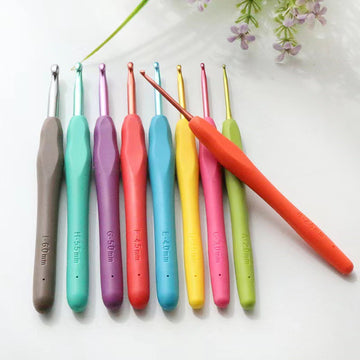
An ergonomic hook has a thicker, often contoured handle made of soft material like silicone, rubber, or padded plastic. The wider diameter means your hand does not have to close as tightly to grip the hook, reducing muscle fatigue. The soft material cushions the pressure points where the hook presses against your fingers and palm. Some ergonomic hooks also have flattened sections or finger rests that guide your hand into a more neutral position.
Research on tool ergonomics consistently shows that increasing handle diameter from approximately 6 mm (a standard hook) to 10 to 12 mm (an ergonomic hook) reduces grip force by 25 to 40 percent. That reduction may not feel dramatic in the first 15 minutes, but over a two-hour crochet session, it is the difference between finishing comfortably and putting down your hook with aching hands.
Hook Grip Styles and Their Ergonomic Implications
There are two main ways to hold a crochet hook, and each has different ergonomic considerations:
The Pencil Grip: You hold the hook like a pencil, with the shaft resting between your thumb and index finger and the handle against the webbing of your hand. This grip gives you very fine control — great for detailed amigurumi work — but it tends to flex the wrist forward and put the thumb in an extended position. Over time, the pencil grip can strain the tendons that run through the wrist and contribute to carpal tunnel symptoms. If you use a pencil grip, pay extra attention to keeping your wrist straight (not bent) and take frequent breaks to stretch your thumb back.
The Knife Grip: You hold the hook like a knife, with your hand wrapped around the handle from above. This grip tends to keep the wrist in a more neutral position, which is generally better for the carpal tunnel. However, it uses more thumb movement to guide the yarn, which can strain the tendons on the thumb side of the wrist (De Quervain's area). If you use a knife grip, focus on moving the hook with your whole hand and forearm rather than isolating the movement to your thumb and wrist.
Neither grip is objectively "wrong." The best grip is the one that feels natural to you — but being aware of the strain patterns of each grip lets you take preventive measures. Some crocheters switch between grips during a long session to distribute the load across different muscle groups.
Hook Material and Weight
Hook material also affects comfort. Aluminum hooks are lightweight, which sounds good, but very light hooks can actually increase strain because you need more muscle tension to stabilize them during fine movements. A hook with some weight — like those with wooden or ergonomic handles — provides natural stability. Wooden and bamboo hooks also have slightly more friction against the yarn than metal, which means you do not need to grip as tightly to keep stitches from sliding off. The trade-off is that yarn slides less smoothly on wood, which may slow you down slightly. For amigurumi, where tight tension is important, the extra friction can actually be helpful.
Setting Up Your Crochet Workspace
Chair and Seating Position
Your chair is the foundation of your crochet posture. Ideally, you want a chair that supports your lower back (lumbar support) and allows your feet to rest flat on the floor with your knees at roughly a 90-degree angle. If your feet do not reach the floor, use a footrest or a stack of books. Dangling feet pull your pelvis forward, which curves your lower spine and cascades into neck and shoulder strain.
Avoid crocheting for long periods on a sofa where you sink into soft cushions. The deep, unsupported sitting position rounds your shoulders forward and tilts your head down — the worst possible posture for your neck and upper back. If you do crochet on a sofa, use a firm cushion behind your lower back and prop your arms on pillows so your elbows are supported at roughly the same height as your work.
Arm and Elbow Support
One of the most overlooked aspects of crochet ergonomics is arm support. When your arms are unsupported, your shoulder muscles (primarily the trapezius and deltoids) must constantly contract to hold your arms in position. Over a long crochet session, this leads to the burning ache between your shoulder blades that many crafters know all too well.
The solution is simple: support your elbows and forearms. Armrests on your chair are ideal if they are at the right height. If not, pillows on your lap, a nursing pillow (which wraps around your waist), or even a folded blanket can support your arms while keeping your hands free to work. The goal is for your shoulders to be relaxed and down, not hunched up toward your ears, and for your elbows to be bent at roughly 90 degrees.
Lighting and Eye Strain
Poor lighting makes you lean closer to your work, which strains your neck and upper back. For amigurumi especially — where you are often working with small stitches, dark yarns, and tight tension — good lighting is non-negotiable. A daylight-spectrum LED lamp positioned to shine directly on your work (not from behind you, where your head casts a shadow) reduces eye strain and keeps you from hunching forward. Magnifying lamps are a worthwhile investment if you do a lot of detailed work or if your eyes tire easily. They let you keep your head upright while still seeing every stitch clearly.

Stretches and Exercises for Crocheters
Why Stretching Matters
Crochet keeps your hands in a relatively fixed, flexed position for long periods. The muscles and tendons on the palm side of your hand and forearm shorten, while those on the back side lengthen and weaken. Over time, this imbalance contributes to pain and dysfunction. Stretching counteracts this by lengthening the shortened tissues and activating the weakened ones.
The best approach is to take a short break every 20 to 30 minutes — set a timer if you tend to lose track of time — and do a quick set of stretches that takes 60 to 90 seconds. Think of it as a "micro-break" rather than an interruption. Your hands will feel fresher when you resume, and your overall crochet speed and quality will actually improve because you are not fighting fatigue.
Five Essential Stretches for Crocheters
1. Wrist Extensor Stretch: Extend your right arm straight in front of you with your palm facing down. Use your left hand to gently pull the fingers of your right hand down and back toward your body until you feel a stretch along the top of your forearm and wrist. Hold for 15 to 20 seconds. Repeat on the left side. This stretches the muscles that get tight from gripping the hook.
2. Wrist Flexor Stretch: Extend your right arm straight in front of you with your palm facing up. Use your left hand to gently pull the fingers of your right hand down toward the floor until you feel a stretch along the underside of your forearm. Hold for 15 to 20 seconds. Repeat on the left side. This stretches the muscles and tendons that run through the carpal tunnel.
3. Finger and Thumb Stretch: Open your hand as wide as possible, spreading all five fingers apart. Hold for 5 seconds, then make a gentle fist. Repeat 5 to 10 times. For the thumb specifically, make a thumbs-up gesture, then use your other hand to gently pull the thumb back toward your wrist until you feel a stretch at the base of the thumb. Hold for 15 seconds.
4. Neck and Shoulder Release: Sit up straight. Slowly tilt your head to the right, bringing your right ear toward your right shoulder. Keep both shoulders relaxed and down. Hold for 15 to 20 seconds, then repeat on the left side. Next, turn your head to look over your right shoulder, hold for 10 seconds, then look over your left shoulder. These simple movements release the neck and upper trapezius tension that builds from looking down at your work.
5. Shoulder Rolls and Chest Opener: Roll your shoulders backward in a large circle 5 times, then forward 5 times. Then clasp your hands behind your back, straighten your arms, and gently lift your clasped hands away from your body while opening your chest. Hold for 10 to 15 seconds. This counteracts the forward-hunched posture that crochet encourages.
Strengthening Exercises for Long-Term Prevention
Stretching relieves tension, but strengthening the opposing muscle groups provides lasting protection. The muscles on the back of your forearm (extensors) open your hand and extend your wrist — the opposite of the gripping motion you use for crochet. Strengthening these muscles helps balance the forces across your wrist joint.
A simple exercise: wrap a rubber band around all five fingertips. Open your hand against the resistance of the rubber band, spreading your fingers as wide as possible. Hold for 3 seconds, then relax. Repeat 10 to 15 times on each hand. Do this a few times a day, not just during crochet sessions. Over weeks, you will build endurance in the muscles that oppose your crochet grip, reducing your overall strain.

Crochet Tension and Its Impact on Hand Health
The Problem with Overly Tight Tension
Amigurumi crocheters are especially prone to tight tension — and for good reason. Tight stitches prevent stuffing from showing through, give amigurumi its firm, defined shape, and create the dense fabric that makes these little creatures so satisfying to hold. But excessively tight tension comes at a cost: every stitch requires more force to insert the hook, yarn over, and pull through. Multiply that extra force by thousands of stitches, and your hands are working significantly harder than they need to.
The goal is to find the sweet spot: stitches tight enough to create a clean, gap-free fabric, but not so tight that you are fighting the yarn with every stitch. A good test: you should be able to insert your hook into the next stitch with moderate pressure, not forceful pushing. If you have to wrestle the hook through, your tension is too tight. Try going up half a hook size — the slightly larger hook creates slightly larger loops, which are easier to work into, while the yarn itself still fills the space because of your natural tension.
Yarn Choice and Tension
Some yarns demand more tension than others. Cotton yarn, popular for amigurumi because of its stitch definition, has almost no stretch. Every stitch requires your hand to do all the work of opening the loop and pulling the yarn through. Acrylic yarn has more give, which means the yarn itself does some of the work for you. For beginners or anyone experiencing hand pain, acrylic is the gentler choice. If you love the look of cotton, consider a cotton-acrylic blend, which offers some of cotton's crispness with some of acrylic's stretch.
Chenille and velvet yarns — increasingly popular for amigurumi because of their soft, plush texture — present a different challenge. They are thicker and fuzzier, which means the stitches are harder to see and the yarn has more friction against itself. This can lead to tighter gripping and more eye strain. If you are working with chenille yarn, invest in excellent lighting and take breaks more frequently than you would with smooth yarn.
Special Considerations for Different Crocheters
Crochet for Seniors and Those with Arthritis
Many people discover or return to crochet in retirement, when they have more time for hobbies. But age-related changes — reduced grip strength, arthritis in the hands, less flexible joints — can make traditional crochet uncomfortable. The good news is that a few adaptations can keep crochet accessible and enjoyable well into later life.
First, an ergonomic hook is non-negotiable. Look for hooks with thick, cushioned handles — some are as wide as a marker pen — that minimize the finger flexion needed to grip. Some ergonomic hooks are specifically designed for arthritic hands, with oversized handles and textured grips that do not require a tight hold to maintain control.
Second, choose projects with larger stitches and thicker yarn. Amigurumi made with bulky or super bulky yarn uses larger hooks (6 mm to 8 mm) and requires fewer stitches overall, which means less repetitive motion. A chunky amigurumi bear made with bulky yarn might take half as many stitches as the same design in worsted weight, reducing the total workload on your hands by 50 percent.
Third, consider using a crochet tension ring or yarn guide. These are small rings that sit on your finger and hold the yarn at the correct tension, reducing the need to wrap yarn around your fingers — which can be painful with arthritis. They are inexpensive and can make a dramatic difference in comfort.
Crochet During Pregnancy and Postpartum
Pregnancy hormones (specifically relaxin) loosen ligaments throughout the body, including in the wrists and hands. This increased joint laxity makes pregnant crocheters more susceptible to wrist strain and carpal tunnel symptoms. If you crochet during pregnancy, be extra vigilant about wrist position — keep your wrists as straight as possible — and reduce your session length. The same applies during the postpartum period while hormone levels normalize. Many crocheters find that using a nursing pillow as an arm support while crocheting is doubly useful during this time.
When to Seek Medical Help
Mild muscle fatigue after crocheting — the kind that goes away within an hour or by the next morning — is normal and not a cause for concern. But certain symptoms should prompt you to see a doctor or physical therapist:
- Numbness or tingling in your fingers, especially if it wakes you up at night (classic carpal tunnel symptom)
- Pain that persists for more than a day after you stop crocheting
- Sharp, shooting pain (as opposed to a dull ache)
- Weakness in your grip — dropping objects, difficulty opening jars
- Swelling or warmth around any joint in your hand or wrist
- A finger that locks or catches when you try to straighten it
These symptoms indicate that inflammation or nerve compression has progressed beyond what rest and stretching alone can resolve. Early intervention — which may include splinting, physical therapy, or anti-inflammatory treatment — is far more effective than waiting until the pain is severe. Most crochet-related RSIs respond very well to conservative treatment when caught early.
Building Healthy Crochet Habits That Last a Lifetime
The goal of crochet ergonomics is not to turn your hobby into a clinical exercise — it is to make sure you can keep crocheting for as long as you want to. The habits that matter most are also the simplest: use an ergonomic hook, sit in a supported position with good lighting, take short breaks to stretch, and listen to your body when it sends warning signals.
If you are just starting your crochet journey, you have a real advantage: you can build these habits from the beginning, before any bad patterns set in. A Crochet Amigurumi Kit that includes an ergonomic hook gives you the right tool from day one. Pay attention to how your body feels during and after crocheting — not obsessively, but with the same gentle awareness you would bring to any physical activity you enjoy.
Crochet is meant to be a source of calm, creativity, and satisfaction. With a few simple ergonomic adjustments, it can stay that way for a lifetime.
Frequently Asked Questions About Crochet Ergonomics
How long can I crochet without risking injury?
There is no universal safe duration — it depends on your technique, tools, posture, and individual anatomy. However, as a general guideline, most physical therapists recommend taking a 5 to 10 minute break every 45 to 60 minutes of crocheting, with shorter "micro-breaks" (30 to 60 seconds of stretching) every 20 to 30 minutes. If you are new to crochet, start with 30-minute sessions and gradually increase as your hand muscles build endurance. If you experience any pain during or after crocheting, reduce your session length immediately — pushing through pain is the fastest route to a chronic injury.
Are ergonomic crochet hooks really worth it?
Yes. An ergonomic crochet hook costs between $5 and $15 — a fraction of what you would pay for a single physical therapy session or a wrist splint. The wider handle reduces grip force by 25 to 40 percent, and the cushioned material distributes pressure across a larger area of your hand. For anyone who crochets more than an hour per week, an ergonomic hook is the single most cost-effective injury prevention investment you can make. Many crocheters report that switching to an ergonomic hook eliminated hand pain they had accepted as "just part of crocheting."
What should I do if my hands hurt while crocheting?
Stop immediately. Continuing to crochet through pain will worsen any underlying inflammation or strain. Rest your hands, apply a cold pack if there is swelling (15 minutes on, 15 minutes off), and do gentle stretches once the acute pain subsides. When you resume crocheting, reduce your session length, check your posture and grip tension, and consider whether your hook or yarn choice is contributing to the problem. If pain recurs every time you crochet, see a doctor or physical therapist — recurring pain is a sign that something needs to change, not a sign that you need to "tough it out."
Can crochet cause permanent damage to my hands?
If RSI symptoms are ignored for months or years, yes, permanent damage is possible. Chronic carpal tunnel syndrome can lead to permanent nerve damage, resulting in lasting numbness and weakness. Chronic De Quervain's tenosynovitis can cause thickening of the tendon sheath that may require surgery to release. However, these outcomes are almost entirely preventable. The vast majority of crochet-related hand and wrist problems resolve completely with early intervention — rest, ergonomic adjustments, stretching, and, if needed, physical therapy. The key is not to ignore early warning signs.
Is it better to crochet with a pencil grip or knife grip for ergonomics?
Neither grip is inherently better or worse — each has different strain patterns. The pencil grip tends to flex the wrist more, which can contribute to carpal tunnel symptoms, but it uses less thumb movement. The knife grip keeps the wrist in a more neutral position, which is better for the carpal tunnel, but it uses more thumb motion, which can strain the tendons on the thumb side of the wrist. The best approach is to be aware of your grip's tendencies and take preventive measures: wrist stretches for pencil grippers, thumb stretches for knife grippers. Some crocheters alternate between grips to distribute the load.
Does yarn choice affect hand comfort?
Yes, significantly. Stretchy yarns like acrylic and wool blends are easier on your hands because the yarn itself absorbs some of the force of each stitch. Inelastic yarns like 100% cotton require your hands to do all the work of opening each loop and pulling through, which increases strain. Chenille and velvet yarns create more friction against the hook and themselves, requiring more force per stitch. For beginners or anyone with hand sensitivity, a soft acrylic or acrylic-wool blend in worsted weight is the gentlest starting point.


